
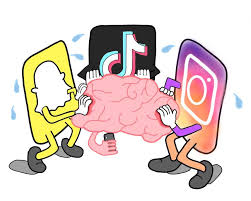
I came across this on my computer as I attempt to organize my life. I wrote this awhile ago and forgto about it so figured why not share.
I have to admit, as a parent, I am guilty of providing my kids with cell phones and gaming systems. I was not great at regulating their ‘screen time’, nor mine to be honest. I do not game but damn those reels take over my ADHD brain.
I had the quintessential mom minivan with video screens, funny thing is I remember driving my youngest to kindergarten in his das car when I heard his four-year-old voice say, “Mom, you need to get a F#@ing TV for this car”. Shocked, I did not react, I kept a straight face and just kep driving, as I mentioned, I was guilty of providing my kids with a gaming system. What harm could come from his watching his brother’s game? I learnt that day. I remeber his dads response when I told him was “at least he used it in proper context”. Enough rambling, the thing I wrote is below…
ADHD, a term we often use loosely, is paradoxically both a casual remark and a serious condition. In our tech-driven world, it’s common to hear someone say, “Everyone is a little ADHD.” This seemingly light-hearted comment takes on a thought-provoking twist when juxtaposed with our tech-saturated environment. Did we do this? Is ADHD a product of capitalism? And if so, why do we ostracize those who have mastered it? Psychology Today article titled: The ADHD Brain: Quintessential Supercomputer? States: “The ADHD brain is a true Executive brain; non-linear, super-fast, creative, decisive. It just doesn’t count all of
the beans, zips about and can’t often tell you how it got there”. Having adapted to the current attention economy, it could be said that the ADHD brain has evolved to meet current social demands.
In 2011, Mark Fisher wrote in his book Capitalist Realism that “ADHD was a pathology of the late capitalism – a consequence of being wired into the entrainment control circuits of hypermediated consumer culture.” Though written before TikTok’s rise and Facebook’s reels, his words seem eerily prophetic. Today, information like one-bite brownies is devoured by youth; anything longer than 30 seconds, and they have tuned out.
It’s impossible to ignore the role of parents and technology companies in shaping children’s tech habits. I see toddlers with iPads and elementary school students glued to their iPhones. Kids not old enough to feed themselves, read, walk or communicate clearly can flawlessly navigate technology, zoom in on images, and throw tantrums when it’s taken away. Apple even has a link to help set up your child’s iPad; they never miss a marketing opportunity.
I recently came across a blog about how to break up with TikTok; the ridiculousness is that TikTok itself has a challenge not to touch your phone for 30 seconds. What a world we live in. We struggle with social interactions, but also need guidance on how to break up with our electronics.
There are concerns about this societal shift towards shorter attention spans. Critics argue that it can hinder our ability to engage with complex ideas, hold meaningful conversations, or regulate our emotions. We’re living in a world of instant gratification, where information is consumed in small, bite-sized pieces like candy, leaving us addicted to the sugar and always craving more. We have inadvertently created a generation of youth raised to gather critical information in the shortest time possible. What is overwhelming for many educators is just a regular day for the neurodivergent brain that functions smoothly with multiple tabs open.
Gen Alpha, born between 2010 and 2024, should be labelled Generation Apple. They graduate from one device to another, from the iPad to the smartphone. Consumed and raised by technology and fueled by their dopamine addictionbefore they can even walk. A parent needs to go to the washroom, here is an iPad, restless at the restaurant, here is an iPad. We have created a whole generation that can only focus on anything for a maximum of 30-second intervals.
It is intriguing to consider whether ADHD, a condition that has come to wield such influence, is a product of our current society. Most aspects of our current world experiences are bombarded by non-linear, unstructured technology, or at least an app. Despite this truth, the current education system dictates all aspects of the standardized curriculum that demands students sit still, refrain from disrupting, speak when spoken to, and pay attention.
Our TikTok brains are left confused by the monotony. You want me to do what? Sit quietly in this ergonomically incorrect chair? Listen for hours while someone preaches to me about something meaningless? What do you mean by “pay attention?” I am bored; this is taking too long. Please get to the point or make a video about it, preferably on TikTok.
This brings us back to the crucial question: Is ADHD an adaptation to capitalism? It’s a difficult truth to face, but we might have. The real challenge is how to rectify this situation when the Ontario Ministry of Education fails to recognize ADHD as qualifying within one of its categories of exceptionality. The system needs to catch up and adapt to these changes. The urgency of this issue cannot be overstated. We must start rethinking our educational approach to accommodate our youth’s changing attention patterns.
In a technologically saturated capitalist world of shortened attention spans and increased ADHD diagnoses, it is time we reconsidered our educational approach better to accommodate the changing attention patterns of our youth.
Is ADHD an adaptation to capitalism? Gen Alpha, born between 2010 and 2024, has been raised by technology, graduating from the iPad to the smartphone. A TikTok generation of youth raised with shortened attention spans and the ability to gather critical information in the shortest time possible. The Ontario education system’s standardized approach to education continues to exclude ADHD as qualifying within one of five categories of exceptionality. Lecce’s “Back to Basics” approach, with additional explicit, systematic, direct, province-wide expectations for instruction, indicates he is doubling down on an already inequitable system that neglects our youth’s changing attention patterns.
 Random Acts of ADHD: ADHD is not what you do but who you are
Leave a comment